
 الاعلام و العلاقات الثقافية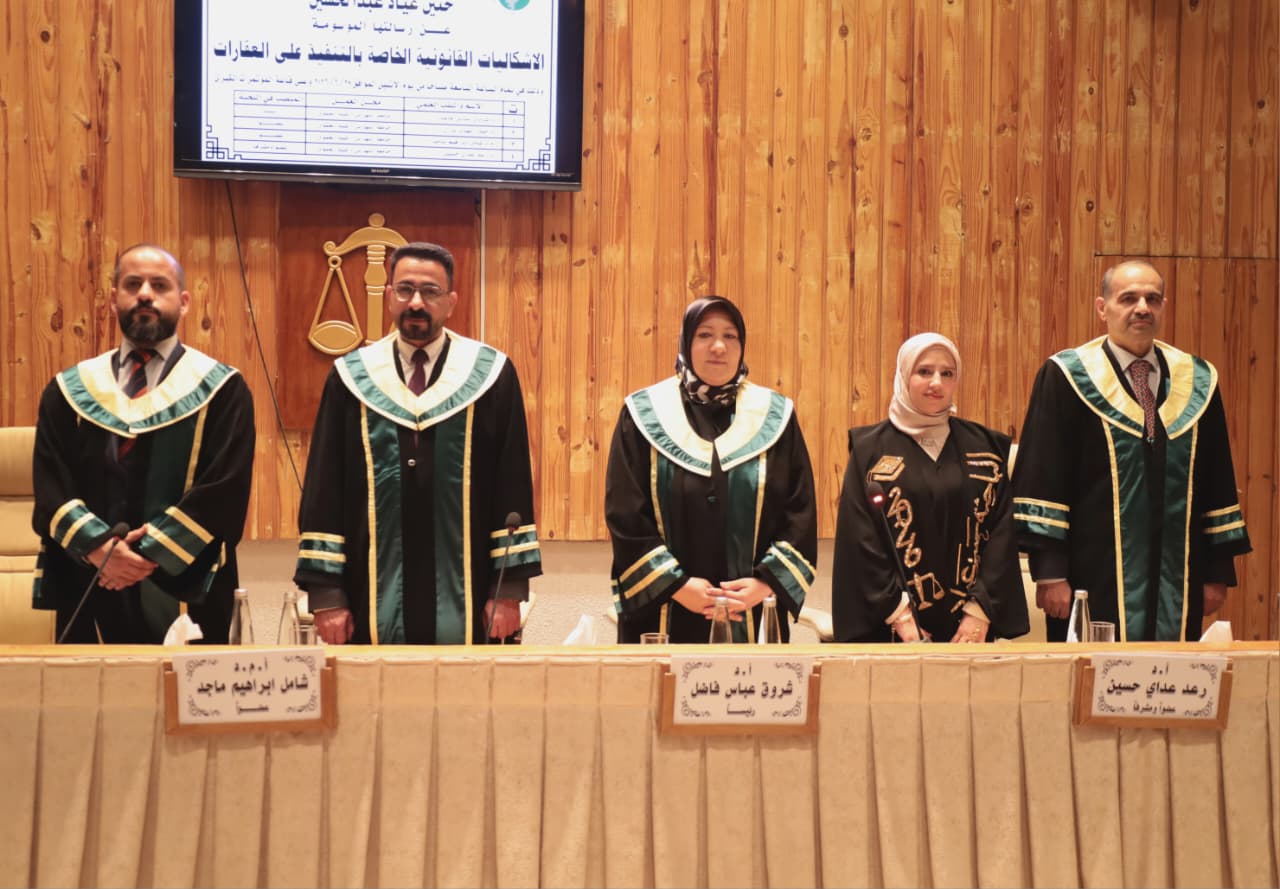
The College of Law at Al-Nahrain University discussed the master’s thesis entitled “Legal Issues Concerning Enforcement against Real Estate”, submitted by Haneen Iyad Abdul-Hussein, a postgraduate student in the Department of Private Law.
Significance of the Study
Compulsory enforcement represents the final stage of judicial proceedings and the practical means by which a creditor can recover a right established by a judgment or enforceable instrument after the debtor has failed to fulfill the obligation voluntarily. The significance of this stage becomes particularly evident when enforcement concerns real estate, given the considerable economic and social value of real property and the serious consequences that may result from affecting it, including impacts on the stability of transactions and the rights of individuals, whether they are parties to the enforcement proceedings or third parties.
However, enforcement procedures against real estate may involve legal obstacles and impediments that can hinder the enforcement process or affect its validity and legality. These are referred to as enforcement issues, which may be provisional, intended to provide urgent and temporary protection for legal positions, or substantive, aimed at resolving a dispute concerning the underlying right or the validity of the enforcement itself.
The seriousness of such issues increases when conflicting interests arise and the rights of creditors, debtors, and third parties overlap, making it necessary to establish a precise legal framework that balances the promptness of enforcement with the protection of rights.
Objectives of the Study
This study aims to clarify the concept of enforcement issues and determine their legal nature, establish an accurate definition of provisional and substantive enforcement issues, and identify the fundamental differences between them.
It also seeks to analyze the major legal issues arising from enforcement procedures against real estate under Iraqi legislation and to highlight legislative shortcomings in Iraqi legal provisions through comparison with comparative legislation, particularly French and Egyptian law.
Furthermore, the study proposes a number of solutions and recommendations aimed at developing and harmonizing the legal provisions governing enforcement issues and obstacles, in a manner that achieves a balance between protecting the rights of creditors and debtors and helps prevent the abuse of rights.
The discussion committee consisted of:
- Prof. Dr. Shorouq Abbas Fadhil – Chairperson
- Prof. Dr. Haider Mahdi Nazzal – Member
- Asst. Prof. Dr. Shamil Ibrahim Haraj – Member
- Prof. Dr. Raad Adai Hussein – Supervisor
Following the discussion and evaluation of the thesis, the committee decided to accept the thesis subject to the required amendments and recommended awarding the student the master’s degree.
